

- Sometimes it takes me a while to connect the dots….
- Maybe adopting Kirky as Nqweba’s mascot would make the disgruntled happier with the 22 March 2024 name change from Kirkwood to Nqweba.
Nqwebasaurus was first discovered approximately 5 km west of then Kirkwood, by William J. de Klerk and Callum Ross in July 1996 during a joint expedition led by the Albany Museum in Makhanda and Stony Brook in New York, United States, where Callum Ross was affiliated at the time.
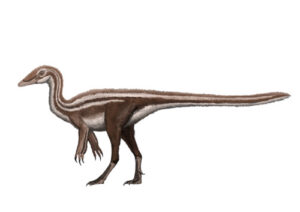 Nqwebasaurus is a basal coelurosaur and the basal-most member of the coelurosaurian clade Ornithomimosauria from the Early Cretaceous of South Africa.
The name Nqwebasaurus is derived from the Xhosa word Nqweba which is the local name for the Kirkwood district, and thwazi is ancient Xhosa for “fast runner”.
Currently it is the oldest coelurosaur in Africa and shows that basal coelurosaurian dinosaurs inhabited Gondwana 50 million years earlier than previously thought. The type specimen of Nqwebasaurus is the only fossil of its species found to date and was found in the Kirkwood Formation of the Uitenhage Group. Nqwebasaurus has the unofficial nickname “Kirky”, due to being found in the Kirkwood District.
The fossil is remarkably complete and is considered an extremely rare find as no coelurosaur fossils had previously been found in Africa at this time. No new Nqwebasaurus fossils have been discovered since.
Small enough to be a pet:
Nqwebasaurus is considered to have been a small to medium-sized coelurosaur. The type specimen is approximately 30 cm high and is estimated to have been 90 cm long, although its complete length is not known due to the caudal vertebrae of the type specimen being incomplete.
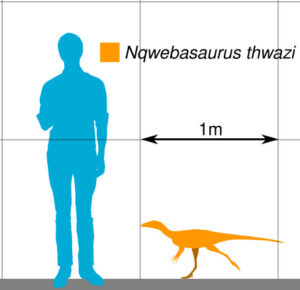 Gregory S. Paul estimated its adult size at 1 m in length and 1 kg in body mass. In addition the type specimen is thought to be a late juvenile, although with the type specimen being the only fossil representing its species it is currently not possible to compare the fossil with another member of its species.
Nqwebasaurus has a long, three-fingered hand which includes a partially opposable thumb with a recurved claw. The claws on its hands differ in shape where the claws of the first and second digits are recurved and the third claw is not. This trait is unusual in theropod dinosaurs, however, it has been observed in some ornithomimosaurs such as Struthiomimus.
Nqwebasaurus also lacks serrations on its maxillary teeth, has a reduced dentition, and contains gastroliths in its abdominal cavity. Again this is unusual trait for carnivorous theropod dinosaurs as gastroliths are more commonly found in herbivorous vertebrates and modern ostriches. Due to these morphological traits, Nqwebasaurus is thought to have been an omnivore.
As more basal theropod species, especially those on the evolutionary line to birds, had feathers it is accepted that Nqwebasaurus was likely at least partially feathered or had a feather coat for thermoregulation.
Years ago Gqeberha had a cute penguin mascot (when it was Port Elizabeth), maybe it is time for Nqweba to claim Kirky as their mascot?
